Heraklion Archaeological Museum: What to See and How It Fits with Knossos
6 min read
The objects found at Knossos are part of the story that the palace alone cannot tell. They are in the Archaeological Museum, in the middle of Heraklion, and it is the one rainy-day or midday-heat stop in the area that is also genuinely important. The collection runs from the Neolithic to Roman times, but the reason to come is the Minoan collection: frescoes, gold, seals, and the enigmatic Phaistos Disc.
The short answer. Go, and go before Knossos if you can. For a self-guided visit take the museum ticket with audio guide: rated 4.4/5; review count: 530; from €27 per person. It is non-refundable and includes a regular adult admission ticket, so check your eligibility for free or reduced admission before buying. If you want someone to pick out the pieces that matter from thousands of objects, book the guided walking tour of the museum: 1.5 hours in English, limited to 10 participants, rated 4.9/5; review count: 27; from €125 per person, with museum admission payable separately.
Check dates and prices for the Archaeological Museum ticket with audio guide
Why the museum comes first
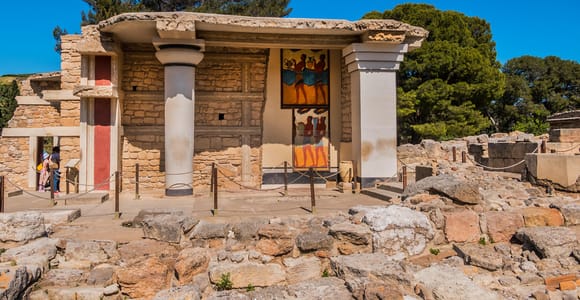
At Knossos you see plan and atmosphere. In the museum you see what was found there: the painted plaster, the goddess figurines, the stone vessels. The frescoes you admire at the palace are largely restored or reconstructed on the site; the surviving fragments are here. If you do the museum first, the palace stops being a pleasant walk through concrete columns and becomes a place where you know what stood in each room. That is our opinion, not a rule, and a visit the other way round works too. What matters is doing both.
What to look for
A museum with this many objects wears you out if you try to see them all. Start with these highlights of the collection:
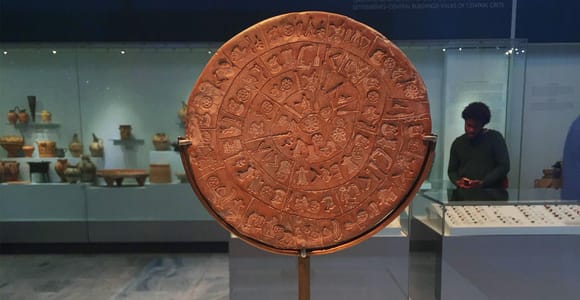
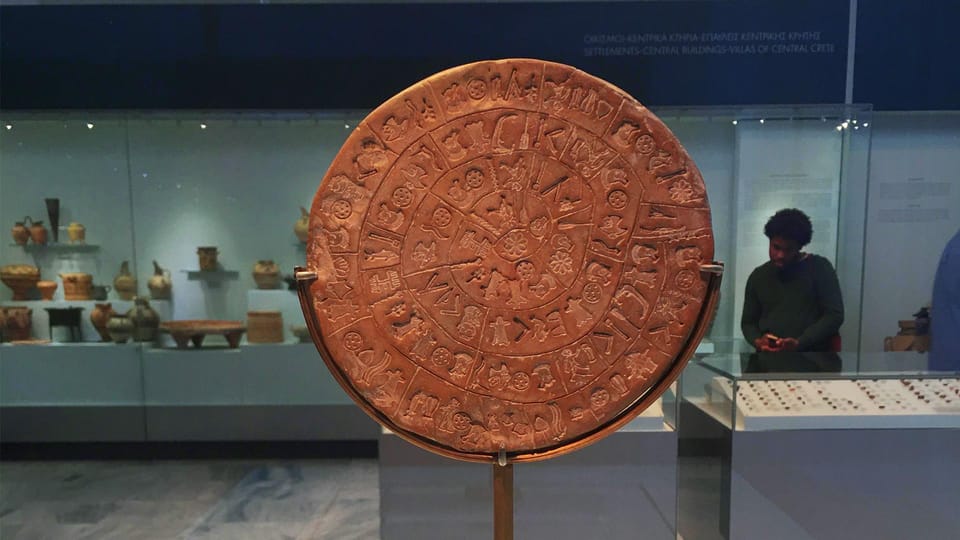
- The Phaistos Disc. A small clay disc stamped with symbols on both sides, found at the palace of Phaistos on the south coast. Its inscription remains enigmatic.
- The snake goddess figurines. Small faience figures of women holding snakes, among the best-known images of Minoan religion.
- The bull-leaping fresco. Figures vaulting over a bull, from Knossos, dated to 1450–1400 BC by the museum’s exhibit page.
- The Malia bee pendant. Two bees holding a disc that the museum interprets as probably a honeycomb, in gold. Small and easy to miss, which is why it is worth looking for.
- The Harvester Vase and the sarcophagi. The Harvester Vase shows a procession carrying agricultural tools, probably part of a rural religious festival; the sarcophagi introduce Minoan funerary imagery.
Rooms are laid out in rough chronological order over two floors. The museum describes 27 exhibition rooms, arranged in chronological and thematic sections. The frescoes from Knossos sit on the upper floor and are the place to slow down.
Tickets: what you pay and what you get
Hellenic Heritage lists museum admission at €20, or €12 for eligible reduced-rate visitors. Admission is free on the first and third Sundays from November through March, as well as 6 March, 18 April, 18 May, the last weekend of September and 28 October. The ticket-and-audio-guide listing starts at €27 per person and includes regular admission plus a self-guided smartphone audio tour; the ticket and audio-tour instructions arrive by email. Compare the package price with the admission rate you qualify for and decide whether you want the audio guide. For the guided museum walk, budget admission separately: its notes ask you to bring money for the ticket. Those notes quote €12 adult and €6 reduced, while another line gives €20 adult; use the museum’s current €20 standard and €12 reduced tariff rather than the older figures.
For separate purchases, the official pages list standard admission of €20 for the museum and €20 for Knossos. If you want an official combined ticket, ask the museum whether one is available for your date before planning around it. The listing for Knossos Palace and the Archaeological Museum with audio guides bundles both admissions for €53.10 per person, rated 4.0/5; review count: 876. Audio guides require the corresponding option, and the package is non-refundable. Its stated schedule starts at Knossos at 08:00, followed by the museum at 13:30 Thursday–Tuesday or 13:00 Wednesday, so this package does not follow the museum-first suggestion above. Both Clio Muse products require a compatible smartphone: Android 9 or later, or iOS 17 or later; iPhone X and older models are not supported. Bring headphones and download the app and audio before visiting. The combined package is listed as not suitable for wheelchair users and is not recommended for visitors eligible for free or reduced admission.
How long, and when
Allow about two hours for the Minoan rooms and a little more if you take an audio guide seriously. The guided museum walk lasts approximately 90 minutes; allow more time if you want to explore beyond its selected exhibits. For November through March, Hellenic Heritage gives 08:30–15:30 daily except Wednesday, when the museum opens 10:00–17:00; last admission is 20 minutes before closing. The museum’s 2026 opening-hours table gives 08:00–20:00 from 28 April to 31 October, except Wednesday 13:00–20:00.
The museum is closed on 1 January, 25 March, 1 May, Easter Sunday and 25–26 December, according to Hellenic Heritage. Choose an arrival time that leaves enough time before closing, especially on the shorter winter days. The museum’s visitor rules permit amateur photography but prohibit flash and professional equipment; publishing photographs requires the museum’s permission.
For families and people with limited mobility
With children and teenagers, pick out the figures, the disc and the gold before you go, rather than trying to cover every case. The museum’s admission rules give free entry to EU visitors aged 25 or under and non-EU visitors aged 18 or under, with proof of age and nationality. The audio-ticket and combined-package booking pages give narrower non-EU child concessions, so use the museum’s rules when deciding whether to buy a regular adult ticket. The museum confirms wheelchair-accessible public areas, an entrance ramp, a lift and accessible toilets. A wheelchair can be borrowed free of charge on presentation of identification. The museum’s accessibility does not extend automatically to a combined Knossos tour.
Which one fits whom
Independent visitors. Choose the ticket with audio guide if you want smartphone commentary and the regular admission package suits your ticket eligibility, then stop wherever a case catches you.
People who like to understand what they see. The guided walking tour or, if you want the palace as well, the half-day tour of the museum and Knossos: five hours, from €100 per person, rated 4.9/5; review count: 35. Both visits on the half-day itinerary carry an extra admission fee; standard admission is €20 at each site. That tour is not suitable for people with mobility impairments. The half-day tour lists English, Spanish, Italian and French guides and meets at Hari’s Creperiê, Sapoutie 1, in central Heraklion. Its itinerary puts Knossos first, while the description puts the museum first; confirm the order and meeting instructions before departure. Both guided tours allow cancellation up to 24 hours in advance for a full refund. Both have small review counts, so read the recent ones.
No car. Everything in this museum is within the city, so you do not need a coach.
Putting it together
The museum shows the objects that complement a visit to the palace. Our Knossos Palace guide covers the palace; browse the Knossos and ancient sites category for more tickets and tours. If you have another day free and want to leave the city, read about the Spinalonga day trip.